
Clovelly Picarooner
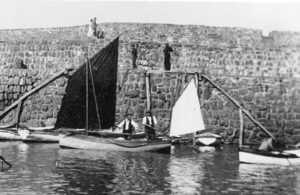
By that time Clovelly’s harbour, often known as Pool Quay, had started to silt up and the big boats were constrained by the tide. To counter this the first smaller boat was introduced in 1880, the hull of which was modelled on the herring boats but, at about 16ft, was much easier to push down to the water’s edge at low tide and could return back at any stage of the tide. Thus they quickly multiplied and were the first back with the catch. The owners of the big boats termed them ‘picarooners’ from the Spanish meaning ‘sea robber’ or ‘pirate’ although no-one seems to know why they used a Spanish term!
Within a few years the older herring boats disappeared so that the herring fleet was made up entirely of picarooners. Many for built in the village were there were various boatbuilders building throughout most of the nineteenth century – Peter Mills, his son John, Tom Waters, Jim Whitefield and a guy named Morris in the early part of that century – whilst others came from Appledore, most notably the Hinks family. There were also yards at Bideford.

In 2007, the students of the Falmouth Marine School had embarked on a new project. This had been mulled about for over a year when considering what West Country boats they should be building on the boatbuilding course. Thus at September they began to construct a new picarooner, modelled on an original vessel that belonged to the National Maritime Museum, Falmouth and which was stored in the same building as the School. This original vessel was the Little Mary, a picarooner believed to have been built in 1898 in Appledore for Clovelly fisherman Alfred Braund. At 15 feet she’s a small picarooner as some were up to 17 feet in length.
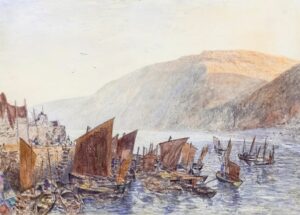
In June of 2008 the new picarooner was completed, the work of construction having been undertaken on the whole by four students on the course. With the Little Mary close by lofting was accomplished by taking direct scantlings from her so that no lines plan was drawn up. The frames were cut with a little bit of refinement though the old Little Mary was pretty fair. Some might frown at this, deeming a set of plans vital, but the finished boat seems not to have suffered at all according to the Clovelly fishermen who are indeed happy with her. The Clovelly Estate Company purchased the boat and this was duly delivered in July having been named Little Lily after the baby born during the year to student Mark Mitchell. The purchase by the Estate was conditional to Stephen Perham using her in his quest for the famous Clovelly herring. A hundred and fifty years or more ago there were some 70 odd boats working from the small harbour with the quality of the fish being superb, according to various reports whilst in the 1880s it was reported that one boat could land 10,000 herring in one day, By 1900 the number of boats had abruptly declined for there were only 15 boats – mostly picarooners – working. A century later this had been reduced further and today only one man fishing the herring in the traditional way. Even in November 2022, the author was able to go out in Little Lily with Stephen in the late afternoon, just as dark was descending, to catch 500 herring with 5 x 35 yards long by 18ft deep nets in about 15 minutes. Because Stephen fishes in a wholly sustainable way, using either the sails or the oars, the vessel remains unregistered.

Little Lily
Sources: 15, 16 & personal experience
If you would like to see the Author’s notes and sources, please download the PDF below.
If you would like to return to the list of boats, please click HERE