
St Ives Gig

For following the autumnal herring season from St. Ives, many fishermen utilised a smaller version of the pilchard driver. Clinker-built rowing and sailing gigs, heavier than the pilot gigs, and measuring between 26 and 32 feet, were either rowed by four oars or sailed with a dipping lug mainsail and a small standing lug or sprit mizzen. Some had centreboards enabling them to sail fast and most were built in St. Ives though a few worked out of Newquay to the north.
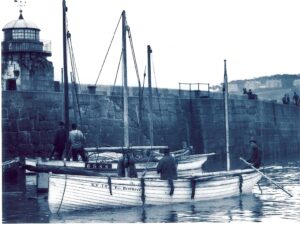
Their main use was being able to get to sea whilst the heavier boats were still ebbed by the tide thus enabling the fishermen a quick shot or two in advance of the bigger boats. With the onset of motorisation in the 1910s, gigs increased in length, up to 40 feet but they retained their openness although the engine – or engines – had a cambered cover over. Tommy Thomas was a prolific builder of these craft in St. Ives, working from his boatshed on the promenade as was Henry Trevorrow and a fellow called Landers. One or two double-ended seine boats were converted into gigs by having a transom stern built on. Some 40 carvel motor gigs were built in total in St. Ives mostly in the 1920s. Whereas Newlyn built motor pilchard drivers, St. Ives built motor gigs which were capable of carrying large amounts of herring. They kept the mizzen lugsail for lying to their drift-nets. By the end of the 1920s these gigs had developed with wheelhouses being fitted, short foredecks added and a higher freeboard. Most were painted light blue whereas the sailing gigs were white. By the 1940s they were hardly recognisable, with capstans fitted for crabbing and trawling. Few remain though St. Ives still has two working as canopy launches whilst Caronia, SS70, a rare gig built in 1927 by Peakes of Newlyn, now called Starfish, is now a pleasure yacht.
Source: 9
If you would like to see the Author’s notes and sources, please download the PDF below.
If you would like to return to the list of boats, please click HERE